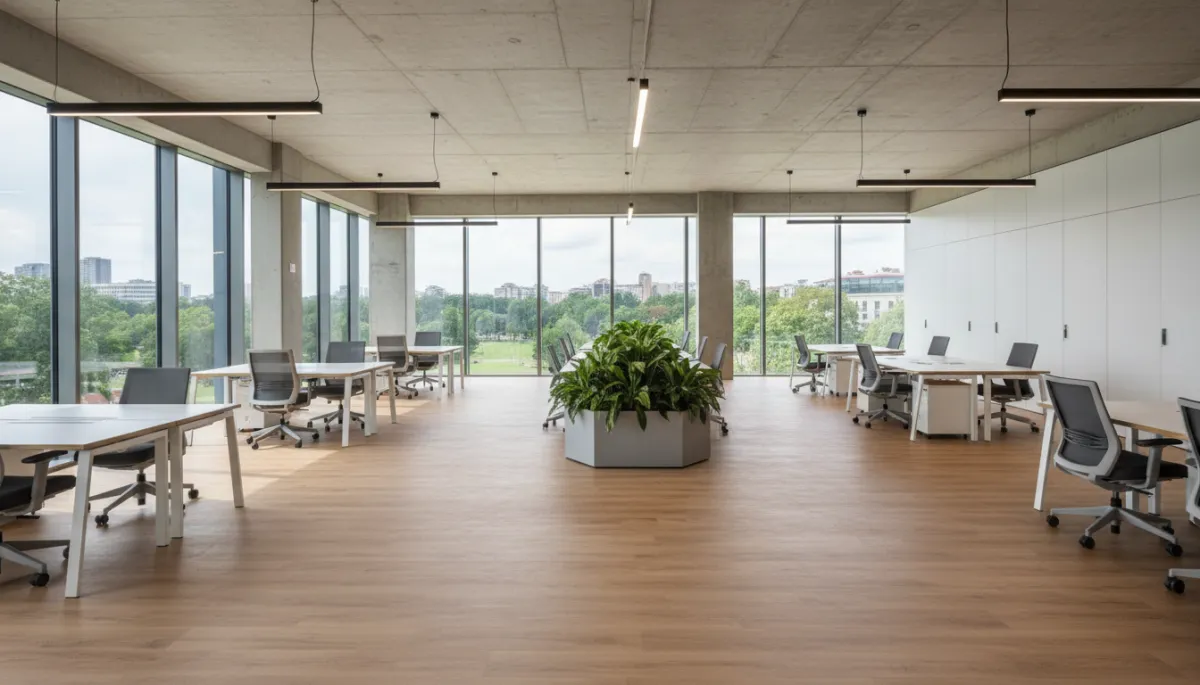
Commercial Flooring Contractor Charlotte, NC
JB Roza Flooring is a commercial flooring contractor serving Charlotte, NC and the surrounding metro with professional installation of LVP, hardwood, and laminate for offices, retail spaces, and rental properties. For commercial spaces in Charlotte, NC, luxury vinyl plank (LVP) is the most practical choice for high-traffic environments, while hardwood and laminate remain strong options for professional offices and boutique retail settings where appearance is a priority. This guide covers the flooring types that perform best in commercial settings, what installation costs and timelines look like in the Charlotte market, and how to select the right contractor for the job.
Table of Contents
- What Types of Flooring Work Best for Commercial Spaces in Charlotte, NC?
- How Much Does Commercial Flooring Installation Cost in Charlotte, NC?
- How Long Does a Commercial Flooring Installation Take in Charlotte?
- LVP vs. Hardwood for Commercial Properties: Which Holds Up Better in Charlotte, NC?
- What to Expect During a Commercial Flooring Installation in Charlotte
- How to Choose the Right Commercial Flooring Contractor in Charlotte, NC
- Frequently Asked Questions About Commercial Flooring in Charlotte, NC

What Types of Flooring Work Best for Commercial Spaces in Charlotte, NC?
The right commercial flooring depends on the type of space, expected foot traffic, and long-term maintenance budget. In Charlotte, NC, where summers are hot and humid, moisture resistance is a practical consideration even for indoor commercial environments — particularly for ground-floor retail spaces and multi-unit rental properties. JB Roza Flooring installs three types of commercial flooring suited to these conditions: luxury vinyl plank (LVP), hardwood, and laminate.
Luxury Vinyl Plank (LVP) for High-Traffic Areas
LVP is the most widely selected commercial flooring choice in Charlotte for businesses with constant foot traffic. It is 100 percent waterproof, resistant to scuffs and dents, and installs directly over most existing subfloors without adhesive. Most commercial-grade LVP products carry wear layers between 12 and 20 mil, which translates to a service life of 15 to 25 years under normal commercial use. Property managers across Huntersville, Concord, and Mooresville frequently choose LVP for rental units and small offices because it is easy to maintain and durable enough to withstand tenant turnover.
Hardwood Flooring for Professional Office and Retail Environments
Hardwood flooring adds warmth and perceived value to commercial spaces such as boutique retail stores, professional offices, and high-end hospitality environments. Pre-finished hardwood installs faster than site-finished options and is ready for foot traffic within hours of installation. In Charlotte's climate, hardwood should be acclimated to the space for at least 72 hours before installation to prevent warping or gapping caused by humidity fluctuations. JB Roza Flooring installs both nailed and glued hardwood for commercial applications, depending on the subfloor type and project requirements.
Laminate Flooring as a Budget-Conscious Commercial Option
Laminate flooring delivers the look of hardwood or stone at a lower material cost, making it a practical solution for commercial spaces with tighter renovation budgets. Modern commercial laminate products are rated AC4 or AC5, indicating suitability for high to very-high commercial traffic environments. Laminate is not waterproof in all configurations, so it is best suited for dry commercial settings such as offices, showrooms, and break rooms rather than spaces with frequent liquid exposure.

How Much Does Commercial Flooring Installation Cost in Charlotte, NC?
Commercial flooring installation costs in Charlotte, NC vary based on the material selected, the square footage of the project, subfloor condition, and layout complexity. Understanding the major cost components helps property managers and business owners build an accurate budget before requesting an on-site estimate.
LVP Installation Cost per Square Foot
Commercial LVP installation in Charlotte typically ranges from $4 to $9 per square foot installed, depending on product grade, wear layer thickness, and installation method. Higher-end commercial-grade products with thicker wear layers and rigid core construction sit toward the upper end of that range but deliver better long-term durability. In a 2,000 sq ft commercial space, total installed costs generally fall between $8,000 and $18,000 before factoring in subfloor preparation or furniture removal. Obtaining an on-site estimate is the most reliable way to get a project-specific number.
Hardwood Flooring Cost for Commercial Spaces
Commercial hardwood installation typically runs $8 to $15 per square foot installed in the Charlotte market, with the wider range reflecting differences between pre-finished and unfinished products. Unfinished hardwood that requires on-site sanding and finishing will push toward the higher end, and the space must remain unoccupied for several days while the finish cures. Properties in Matthews, Fort Mill, or Monroe that have older subfloors may require additional leveling or patching before installation, adding to the overall project cost and timeline.
What Drives the Final Price of a Commercial Project
Several factors beyond material and square footage affect final pricing on a commercial flooring project. Subfloor condition is among the most significant — a concrete slab that is not level may require grinding or patching before any flooring material can be laid. Furniture and equipment removal, transitions between flooring zones, custom cuts around pillars or irregular walls, and access logistics in multi-tenant buildings all contribute to the final number. A detailed on-site estimate that accounts for these variables is the most accurate way to understand the full cost of a commercial installation.
How Long Does a Commercial Flooring Installation Take in Charlotte?
Installation timelines for commercial flooring in Charlotte depend primarily on the square footage of the space, the complexity of the layout, and the material selected. Most commercial projects can be planned around business operating hours to minimize disruption, though subfloor preparation phases generate dust and noise that may require the immediate work area to be cordoned off.
Small Office or Retail Space (Under 1,500 sq ft)
For offices, retail units, or rental properties under 1,500 sq ft with a straightforward layout and a prepared subfloor, LVP or laminate installation typically takes one to two days. Hardwood installation for the same space takes one to two days for glue-down or nail-down, but site-finished hardwood requires an additional two to four days of drying time before the area can be safely occupied. Many commercial clients in Charlotte's South End, NoDa, and Plaza Midwood neighborhoods complete small installations over a weekend to avoid disrupting business operations during the week.
Mid-Size Commercial Projects (1,500–5,000 sq ft)
Commercial flooring projects in the 1,500 to 5,000 sq ft range typically take three to six business days from start to completion, depending on material selection and subfloor preparation requirements. Projects that involve grinding a concrete slab, installing moisture barriers, or working around fixed commercial fixtures will extend the schedule. Coordinating a phased installation — completing one section of the space at a time — allows portions of the building to remain operational while others are being worked on, a common approach across Concord, Gastonia, Kannapolis, and the broader Charlotte metro.
If you are planning a commercial flooring project in Charlotte, NC or the surrounding area, JB Roza Flooring provides on-site estimates at no cost. Call +1 980 267 5853 or schedule your free in-home estimate to discuss your project scope, material options, and timeline.
LVP vs. Hardwood for Commercial Properties: Which Holds Up Better in Charlotte, NC?
Both LVP and hardwood are capable commercial flooring materials, but they perform differently under the specific conditions found in Charlotte's commercial market. The choice between them depends on budget, aesthetic goals, subfloor type, and the level of maintenance the property owner plans to carry out over time.
Key Insight: Commercial-grade LVP with a 20 mil wear layer can withstand over 10 million foot-traffic cycles, making it one of the most cost-effective long-term investments for rental properties and high-traffic commercial spaces.
Durability and Moisture Resistance
LVP is inherently waterproof and will not swell, warp, or develop mold when exposed to moisture — a meaningful advantage in Charlotte's humid summer climate. Hardwood is more susceptible to moisture fluctuations and requires a controlled indoor environment, particularly in ground-floor spaces or buildings where HVAC systems allow wide temperature and humidity swings. For ground-floor retail spaces, restaurant lobbies, and rental units across Pineville, Indian Trail, and the broader Charlotte metro, LVP is generally the more reliable long-term choice for durability.
Maintenance and Long-Term Cost of Ownership
LVP requires minimal upkeep — routine dry mopping and occasional damp mopping are sufficient to keep it looking new for years. Hardwood can be sanded and refinished multiple times over its lifetime, which periodically restores its appearance but adds labor costs each cycle. A hardwood floor can typically be refinished three to five times before the boards become too thin, making it a durable long-term asset when properly maintained. For commercial properties with stable occupancy and a long-term ownership horizon, hardwood's refinishability makes it a competitive total-cost option despite higher upfront installation costs.
Appearance and Tenant or Customer Appeal
Hardwood creates a premium feel that can support higher rental rates or a more upscale brand experience for retail and office tenants. LVP has improved significantly in visual realism over the past decade and is now nearly indistinguishable from real wood in most installations, particularly from standing height. For most commercial landlords and property managers serving the Charlotte metro, LVP provides a strong balance of visual appeal and practical durability that satisfies the expectations of a wide range of tenants and customers.
What to Expect During a Commercial Flooring Installation in Charlotte
Understanding what happens at each phase of a commercial flooring installation helps property managers and business owners plan more effectively and avoid surprises on project day. A professional installation follows a consistent sequence regardless of the material selected.
Site Assessment and Material Selection
Before installation begins, a flooring contractor visits the space to measure the area, assess subfloor condition, identify transitions and obstacles, and confirm that the selected material is appropriate for the space. During the site visit, questions about traffic patterns, moisture exposure, furniture weight, and business operating hours help shape the installation plan. Property managers should communicate any scheduling constraints during the assessment — such as days the space must remain operational — so the contractor can build a phased timeline that minimizes disruption.
Subfloor Preparation
Subfloor preparation is the phase that most directly determines the final quality of the installation. For concrete subfloors, this typically involves checking for levelness, testing for moisture, and grinding or patching any high and low spots that would affect the finished floor. Wood subfloors require inspection for squeaks, soft spots, and nail pops before any new material is laid. Skipping or shortcutting subfloor preparation is the most common cause of commercial flooring failures — including buckling, gapping, and hollow spots — and is far more costly to correct after installation than before.
Installation and Cleanup
Once the subfloor is prepared, material installation proceeds according to the planned layout, with installers handling cuts, transitions, thresholds, and specialty details around pillars, built-in fixtures, or existing cabinetry. At project completion, the crew removes all debris, trim scraps, and packaging and performs a final walk-through to confirm the space is clean and ready for use. Most commercial LVP and laminate installations allow light foot traffic within hours of completion; hardwood installations require additional cure time if on-site finishing is involved.
How to Choose the Right Commercial Flooring Contractor in Charlotte, NC
The quality of a commercial flooring installation depends as much on the contractor as it does on the material selected. Choosing a flooring contractor with documented commercial experience, clear communication, and a structured approach to project management is essential to getting a result that holds up over years of daily use.
Licensing, Experience, and Local Reputation
A reputable commercial flooring contractor in Charlotte, NC should be properly licensed and insured for commercial work in North Carolina. Experience with the specific material you plan to install — LVP, hardwood, or laminate — matters because each requires different tools, techniques, and subfloor preparation standards. Local contractors who have completed commercial projects across the Charlotte metro understand regional considerations such as typical concrete slab conditions, local building requirements, and the seasonal humidity fluctuations that affect hardwood installation timing and acclimation needs.
Questions to Ask Before You Hire
Before signing a contract with a commercial flooring contractor, confirm whether the estimate includes subfloor preparation, who is responsible for furniture removal, and what the warranty terms are for both materials and labor. Ask whether the contractor will personally oversee the installation or whether the work will be subcontracted to a crew you have not met. Request a written timeline with clear milestones so you can plan any temporary closures or phased operations around the installation schedule. JB Roza Flooring's website provides additional information about the company's commercial flooring services and the communities served across the Charlotte metro area.

Frequently Asked Questions About Commercial Flooring in Charlotte, NC
What is the most durable flooring for a high-traffic commercial space in Charlotte, NC?
For high-traffic commercial spaces in Charlotte, NC, commercial-grade luxury vinyl plank (LVP) with a wear layer of 20 mil or higher is the most durable practical option available today. Commercial LVP is 100 percent waterproof, resistant to scuffing and denting, and requires no refinishing or specialty cleaning products to maintain its appearance over time. Hardwood is also a durable choice but requires more consistent maintenance and is more sensitive to moisture — a real consideration in Charlotte's hot, humid summers. LVP typically costs $4 to $9 per square foot installed and can last 20 or more years under commercial traffic conditions, making it one of the lowest total-cost options over a full ownership horizon.
How much does it cost to install LVP flooring in a 2,000 sq ft commercial space in Charlotte?
For a 2,000 sq ft commercial space in Charlotte, NC, LVP installation typically costs between $8,000 and $18,000 depending on the product grade, subfloor condition, and layout complexity. Lower-end commercial LVP products run approximately $4 to $5 per square foot installed, while high-grade rigid-core options with thicker wear layers run $7 to $9 per square foot. Subfloor preparation, custom transitions, and furniture removal are generally priced separately and can add $500 to $2,500 or more depending on the specific conditions found during the site assessment. An on-site estimate is the most reliable way to get an accurate number for a specific property in Charlotte.
Can flooring be installed in an occupied commercial building without closing it?
In many cases, commercial flooring can be completed in a phased sequence that keeps part of the building operational while work proceeds in another section. A professional flooring contractor will develop a phased installation schedule based on the building's layout and the business's operating requirements. LVP and laminate are particularly well-suited for phased commercial work because they generate no fumes and allow foot traffic within hours of completion in each section. Hardwood installations that include on-site sanding and finishing do require the work area to be vacated due to dust generation and finish off-gassing during the drying process.
How long does commercial LVP flooring last compared to carpet?
Commercial-grade LVP flooring typically lasts 15 to 25 years in a commercial setting, while commercial carpet in a high-traffic environment generally requires replacement every 5 to 10 years. LVP is significantly easier to clean and does not trap allergens, odors, or stains the way carpet does, which reduces ongoing maintenance costs and tenant complaints over time. For rental properties and commercial spaces with frequent tenant turnover — such as offices and retail units across Huntersville, Davidson, and Monroe — LVP's longer service life and easier cleaning make it a lower total cost of ownership than carpet over a 15 to 20-year horizon.
How long does it take to install floors in a mid-size commercial property?
A mid-size commercial property of 1,500 to 5,000 sq ft typically takes three to six business days from the start of subfloor preparation through the completion of installation. Projects with straightforward rectangular layouts and a prepared concrete subfloor fall toward the lower end of that range, while spaces with irregular layouts, multiple flooring transitions, or significant subfloor repair needs run closer to the upper end. Your contractor should provide a written day-by-day schedule before work begins so you can coordinate any necessary business closures or staff scheduling adjustments with adequate advance notice.
Do I need to close my business during a commercial floor installation?
Whether a business needs to close during installation depends on the material selected, the scope of the project, and the layout of the space. LVP and laminate installations can typically be completed in phases without a full business closure, particularly for larger open-plan spaces where sections can be cordoned off while others remain in use. Hardwood installations that include on-site sanding and finishing require the work area to be vacated due to dust and chemical fumes from the finishing products. In most cases, scheduling commercial flooring work over a weekend or during a planned holiday closure allows Charlotte businesses to complete the project with minimal operational disruption.
Schedule a Commercial Flooring Estimate in Charlotte, NC
JB Roza Flooring provides commercial flooring installation across Charlotte, NC and the surrounding metro area, including Concord, Huntersville, Gastonia, Mooresville, Matthews, Fort Mill, and Waxhaw. Whether you are upgrading an office, refreshing a retail space, or replacing floors across a rental portfolio, the team installs LVP, hardwood, and laminate with attention to subfloor preparation, clean project execution, and minimal disruption to your operations.
To discuss your project or request an on-site estimate, call +1 980 267 5853 or visit JB Roza Flooring's website for more information about services and the communities we serve. When you are ready to book, schedule your free in-home estimate directly online at a time that works for your schedule.


